Shooting Unknown on the Streets of Berlin
Cinematographer Flavio Labiano on Flashbacks in Two Film Formats
Unknown, the Warner Bros. feature film starring Liam Neeson, takes a hoary movie premise ‘ a man takes a violent blow and wakes up with amnesia ‘ and turns it on its head. Neeson plays Dr. Martin Harris, whose problem is that everyone around him, including his wife, denies that he is who he claims to be. A sinuous plot unfolds with multiple twists and double-backs. Harris’ realizations aren’t all pleasant as he delves into the Berlin underworld to stall for time while he teases out the truth, which involves a planted bomb, a visiting prince, and a scientist whose discoveries could alleviate hunger across the globe.
Unknown was directed by Jaume Collet-Serra and photographed by Flavio Labiano, a Spanish duo best known for stylish international commercials and the paean to soccer titled Goal II: Living the Dream. Collet-Serra has also directed the features House of Wax and Orphan for Unknown producer Joel Silver. Labiano is an American Film Institute grad with more than 20 features under his belt, most of them home-grown productions made in Spain. Labiano also served as second unit cinematographer for Janusz Kaminski, ASC, on Steven Spielberg’s Indiana Jones and the Kingdom of the Crystal Skull.
The look of Unknown was determined in part by the decision to shoot in Berlin in the winter. The production ran for 48 days during the time of year when daylight begins as late as 9 a.m. and is all but gone by 3 p.m. “It was a challenge, and the weather was incredibly cold at times,” says Labiano. “A scene in the river had to be postponed until the ice, which hadn’t frozen over in 30 years, thawed. But I think shooting in Berlin in the winter really helped underscore the drama and put the audience in the character’s mindset.”
The filmmakers chose a subjective point of view for most of the film, showing the audience what Neeson’s character was seeing, and thus communicating something of what he was feeling. The ARRI Master Prime lenses were usually on the wider side, most often a 32 or 37 mm.

“After extensive pre-production testing, we decided to try something new,” he says. “We shot with a 35mm camera and a Super 16 camera side by side, with a prism redirecting the same image to each camera. We captured two identical images ‘ one with a standard 35mm setup, and one underexposed image on reversal film. We used a nonstandard shutter angle and force-processed and cross-processed the Super 16 image, which resulted in a broken but beautiful, dreamy kind of image. We used Flame software in post to affect the images a bit more. We combined the two images in post, and sometimes quickly flash-cut between the two.
“I was pleased with the result,” says Labiano. “Hopefully, it puts the audience inside Martin Harris’ brain, so to speak. Harris and the audience are both trying to solve this puzzle. So often you see an effects technique that comes from a software program, and suddenly it’s everywhere – on a music video tonight and in a beer commercial tomorrow. This was really a technique we designed for this exact purpose, and because it was an in-camera technique, it’s more organic.”
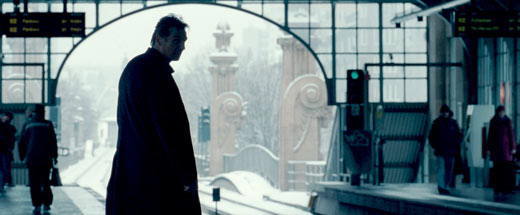
Labiano used ARRI cameras and KODAK VISION3 500T Color Negative Film 5213. “Berlin’s cloudy, overcast skies and short days meant a 500-speed film was a necessity,” he says. “I wouldn’t have tried out a digital format given the extreme weather conditions we faced, including -27 degrees Celsius temperatures. Also, film reacts in a very beautiful way to the soft, low light you get on a cloudy day. For some reason, under those conditions, the separation of colors is especially subtle and lovely.”
Technicolor handled the DI in London. Labiano spent three weeks perfecting the timing and matching shots from various times and places.
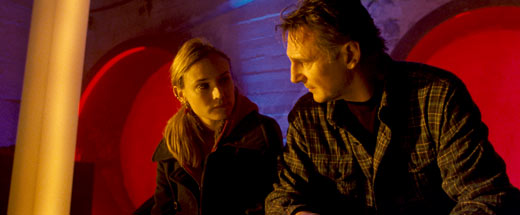
“After extensive pre-production testing, we decided to try something new,” he says. “We shot with a 35mm camera and a Super 16 camera side by side, with a prism redirecting the same image to each camera. We captured two identical images ‘ one with a standard 35mm setup, and one underexposed image on reversal film. We used a nonstandard shutter angle and force-processed and cross-processed the Super 16 image, which resulted in a broken but beautiful, dreamy kind of image. We used Flame software in post to affect the images a bit more. We combined the two images in post, and sometimes quickly flash-cut between the two.
“I was pleased with the result,” says Labiano. “Hopefully, it puts the audience inside Martin Harris’ brain, so to speak. Harris and the audience are both trying to solve this puzzle. So often you see an effects technique that comes from a software program, and suddenly it’s everywhere – on a music video tonight and in a beer commercial tomorrow. This was really a technique we designed for this exact purpose, and because it was an in-camera technique, it’s more organic.”

Labiano used ARRI cameras and KODAK VISION3 500T Color Negative Film 5213. “Berlin’s cloudy, overcast skies and short days meant a 500-speed film was a necessity,” he says. “I wouldn’t have tried out a digital format given the extreme weather conditions we faced, including -27 degrees Celsius temperatures. Also, film reacts in a very beautiful way to the soft, low light you get on a cloudy day. For some reason, under those conditions, the separation of colors is especially subtle and lovely.”
Technicolor handled the DI in London. Labiano spent three weeks perfecting the timing and matching shots from various times and places.
Categories: Creativity, Feature, Project/Case study, Shooting, Technology