Summary: The AG-AF100 is a Micro Four Thirds AVCCAM camcorder with built-in ND filters, a waveform/vector-scope, HD-SDI and HDMI, a large 4/3-inch sensor and 35mm-like depth of field for the price of an HDSLR. It also looks and acts like a traditional video camera, with two-channel audio, and lets you capture images featuring wide dynamic range and detailed gradation with minimal blocked shadows or blown highlights in high-contrast scenes.
What It Costs You: $4,995 for the body; $800 for a Lumix G Vario HD 14-140mm lens tested.
Target Apps: Digital filmmakers looking for the kind of shallow depth of field and image control you can get with film cameras and DSLRs but who want the ergonomics and affordability of an HD camcorder.
What’s Cool: 35mm depth of field, built-in ND Filters, XLR audio with manual control, phantom power, uncompressed audio recording, waveform/ vectorscope, HD-SDI, HDMI and composite video monitoring; the wide variety of lens mounts.
What's Missing: For the cost of this camcorder, nothing.
Specs: Supported Recording Formats: 1080/50i, 1080/25p, 1080/60i, 1080/30p, 1080/24p, 720/50p, 720/25p, 720/60p, 720/30p, 720//24p AVCHD recording options: PH (21 Mbps - Max. 24Mbps), HA (17Mbps), HE (6Mbps), HA, HE only for 1080/60i and 1080/50i
This Loaded HD Camcorder Gives You 35mm-like DOF for the Price of an HDSLR—Without Rolling Shutter or Moiré
Nino Del Padre
March 8, 2011 Source: Studio Monthly
Ever since the introduction of the modern day video camera, digital filmmakers and producers of every genre have been striving for that elusive "film look." The advent of affordable high-definition camcorders like the Panasonic HVX200, with its cinema gamma and 24p recording, has brought us much closer to this. But no matter how good the lighting, composition and subjects are, one thing screams video from a mile away: the lack of cinema-style, shallow depth of field.
DOF, for the neophyte, is a distance range in which objects appear to be in focus. Deep DOF means more of the scene will appear in focus, shallow DOF means the range will be smaller and objects closer or further will appear blurred. Also known as selective focus, it’s artfully used by DPs to naturally draw the viewers’ attentions to the primary subject.
Here at Del Padre Digital, we have had great film-like results in the past with our Redrock M2 Cinema Lens Adapter mounted on our Panasonic HVX200 and, more recently, the RED ONE. In 2009 Canon released the 5D Mark II, primarily a digital SLR still camera, but also with the ability to capture 1080p HD video. This was the first affordable camera capable of mounting still camera lenses with an adapter. With its larger 35mm-sized CMOS sensor, the 5D offered groundbreaking control of depth of field.
Canon enjoyed—and still enjoys—tremendous success with the 5D, launching a huge DSLR video revolution. The one major drawback: the cameras were designed primarily as still cameras and are thus much more difficult to control ergonomically compared to already existing camcorders in terms of operation, handling and monitoring. You need to purchase so many extra accessories just to make it feel more like a video camera.
From lens adapters for cameras like the HVX200 to the pricey and rather large and heavy RED ONE there has been a need for 35mm-like depth of field in the form factor of a traditional video camera that accepts 35mm still or PL-mount lenses. And if it’s going to sell, it’s got to be priced like an HDSLR.
A New Breed
Panasonic put it all together, answering many of our prayers, with their new AG-AF100 film-like digital camcorder. The AG-AF100 is the first professional HD camera recorder to adopt the Micro Four Thirds standards. I really think the AG-AF100 is a digital SLR killer. It’s a real HD camcorder with a form factor similar to the HVX200 and only a slightly higher price.
The AG-AF100 uses a 4/3-inch MOS sensor, which is virtually the same size as a 35mm Hollywood film camera. The MOS sensor has two control lines as compared to the three lines required by a conventional CMOS sensor, providing a larger light receiving area. Extensive noise reduction measures, such as embedded photodiodes isolated from noise sources and low-voltage operation, are also employed. By guiding more light to the pixels, the AG-AF100 achieves a wide dynamic range and detailed gradation with minimal blocked shadows or blown highlights in high-contrast scenes. You get exactly what you’re after: true-to-life textures and rich colors.
To create the amazing-looking shallow depth-of-field you get with the AG-AF100, Panasonic uses an optical low-pass filter, optimized for HD motion images, that reduces the aliasing noise often occurring in motion images captured by an image sensor with a high pixel density. In addition, the MOS image sensor is scanned at a high speed in order to minimize skew distortion.
The result, an HD video camcorder with all the usual camcorder features like white-balance, zebra stripes, cine-gamma settings, timecode recording, balanced XLR inputs with Phantom Power, 48-kHz/16-bit two-channel audio recording, HD-SDI out, HDMI out, headphone out, and a built-in optical ND (neutral density) filter wheel with 2, 4 and 6 stops, so you don’t have to mess around with dropping ND filters into a matte box anymore. You can shoot in bright conditions and use these ND filters to get the lens open for depth of field control with no need to change the shutter speed.
The AF100 records 1920 x 1080 full-HD images. The AVCHD PH mode is compatible with multiple HD formats, such as 1080/60i, 1080/30p, 1080/24p and 720/60p. Additionally, the AG-AF100 series lets you select 60 Hz or 50 Hz to support HD systems used around the world. It also has a variety of over- and under-cranking frame rates in 1080p, which will be familiar to anyone who has used Panasonic’s VariCam series and HVX200 cameras. The camera shoots in AVCHD format at up to 24 Mbps using dual SDXC cards.
Impressive Heft, SD Memory and On-Camera Controls
My first impressions of the camcorder body itself were very good. For starters, it was surprisingly smaller than I pictured it would be in person but it felt solid and all the switches, dials and controls are logically laid out and easy to get to. The camera was shipped to me with a Lumix G Vario HD 14-140mm/F4.0-5.8 lens.
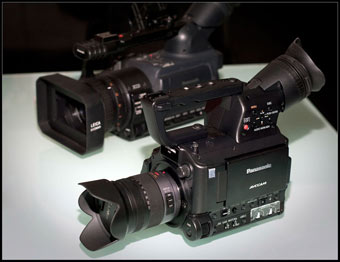
The new AF100 is not much bigger than the HVX200, pictured behind it.
Something that impressed me was the vast volume of footage I could record on SDXC cards. I ordered a Patriot 16GB Card for less than $30 that gave me about 90 minutes of recording time in the highest quality PH Mode at 1920 x 1080. I’m more accustomed to the RED and P2 cameras, where you have to keep your shooting ratio in the back of your in mind, as you can run out of available media if you’re not careful. By contrast, the SDXC cards are so cheap and hold so much footage, there’s really no concern here. You can shoot non-stop all day long on a handful of cards and never have to stop to download if you don’t want or don’t have time to.
The Panasonic AG-AF100 takes interchangeable lenses. Simply buy the adapter you require and stick on your Canon, Nikon, Olympus or a PL-mount lens.
The camcorder has a foldout HD LCD screen. The 3.45-inch LCD screen has very good definition with vibrant colors, making it easy for setting white balance and other basic color adjustments. The screen also displays a very cool waveform monitor for exposure tools with the usual two levels of zebras and colored peaking focus assist with a red/blue outline. There is also a spot meter, and a vector-scope. All these on-board tools make achieving perfect focus and exposure a breeze. I can’t say this enough: The waveform and vector scopes are absolutely fantastic aids that make judging exposure refreshingly easy.
Located behind the LCD screen are various buttons for BARS, ZEBRA, OIS (optical image stabilizer), EVF DTL (electronic viewfinder detail), WFM (waveform monitor), COUNTER, TC SET, and audio controls for CH1 SEL, CH2 SEL, INPUT 1 and INPUT 2. Below the LCD screen you’ll find the usual controls for PUSH AUTO-FOCUS, a FUNCTION mini joystick, USER 1, DISP/MODE CHECK, POWER ON/OFF, CAMERA/MEDIA MODE, IRIS with a dial wheel, GAIN, WHITE BALANCE, USER 2, AUDIO CH1 and CH2 level wheels.
The removable battery is found on the back of the camera where, just above this, you’ll also find two slots for SDHC or SDXC solid-state cards with a cover. To the left of the battery is a SLOT SELECT button, a DIAL SELECT button and a SHUTR/F.RATE dial. I particularly like these on the back of the camera, which let me change my shutter speed, frame rate, and other functions right there on the camera using the dial and the DIAL SELECT button. Previously, I would have had to dig around in the menus—a huge time waster. To the right side of the battery are inputs/outputs for AV OUT, USB 2.0, HDMI, INDEX, CAMERA REMOTE, HEADPHONES and HD/SDI.
Lenses Galore
The Panasonic AG-AF100 has a 4/3-inch Bayonet Micro Mount for interchangeable lenses. This is a digital photographic still camera standard lens mount established by Panasonic and Olympus. This 4/3rd mount is the same one found on digital SLR stills cameras such as Panasonic’s own Lumix models. You can choose from any of Panasonic’s Lumix 4/3-inch mount lenses; they just mount right on. If you have a stack of Nikon AIS or Canon FD lenses from the 1980s, just buy an adapter (literally a mechanical adapter with no optics, so no loss in quality) and use those.
35mm filmmakers will be glad to know that you can also fit C-mount Cinema lenses and Professional PL mount lenses and other 35mm primes to the AG-AF100—again, with the use of an optic-free adapter.
Here’s the lowdown on the recording formats the AG-AF100 supports:
1080/50i, 1080/25p, 1080/60i, 1080/30p, 1080/24p, 720/50p, 720/25p, 720/60p, 720/30p, and 720//24p. The AVCHD recording options are PH (21 Mbps - Max. 24Mbps), HA (17Mbps), HE (6Mbps), HA, and HE only for 1080/60i and 1080/50i.
The AG-AF100 has a lot of potential, and I’d definitely choose it if the alternative was an HDSLR. Its layout and controls are familiar and it’s designed to do what it does, so it’s much faster and easier to program, judge focus and expose than an HDSLR. It also doesn’t create moiré or rolling shutter artifacts the way an HDSLR will.
If you love the shallow depth of field and image control you can get with film cameras and DSLRs but want the ergonomics and affordability of an HD camcorder, this is the camera you’ve been waiting for.
Nino Del Padre founded and launched Del Padre Digital in 1991. Today he oversees a business that now encompasses digital cinematography services, animation and interactive design solutions to ad agencies, corporate clients, broadcast networks and the entertainment industry as well as partnerships with institutions as diverse as LEGO, Hasbro, and NASA.
Comments (25) for "REVIEW: Panasonic AG-AF100 Camcorder"
1.
the 4/3's is NOT about the same size as a S35mm frame. its about 75% smaller. APS-C is a few percent smaller then s35. for references is this chart http://en.wikipedia.org/wiki/File:Sensor_sizes_overlaid_inside.svg
however, that doesn't tell the full story. basically 4/3's makes a lens look 2X longer then it does on APS-C / S35. this menas a 24mm lens on a 4/3's imager is about the same as a 50mm on a APC-C / S35 sensor. thats a very big difference. the stock zoom lenses are also very slow for this camera although perhaps some S16mm glass MIGHT provide image coverage, or not. it would depend on the lens. 16mm is pretty close to 2/3" in video.
either way, while 4/3's can provide more shallow DoF then typical video cameras, its not the same as the larger sensor APS-C or bigger cameras
Posted by Steve oakley on Monday, March 14, 2011 @ 06:28 PM
2.
A 25 mm lens on a mft chip is about equal to a 35mm lens on an aps-c / s35 motion picture camera and a 50mm lens on a FULL frame 35 mm stills camera. It's bout a 30mm on a standard 35mm motion picture frame.
Posted by vince gaffney on Tuesday, March 15, 2011 @ 03:27 PM
3.
AVCHD format at up to 24 Mbps = deal breaker
Posted by Tom Gillen on Tuesday, March 15, 2011 @ 03:33 PM
4.
Steve, you're confused because he 4/3's sensor is almost the same size as cinema film, the 2x is only releated to still cmaeras which are twice as big as movie film. Movies and stills dont use the same frame size. 4/3 provides DoF almost identical to the APS-C cmaeras.
Posted by Samson on Tuesday, March 15, 2011 @ 04:22 PM
5.
Steve I think you are wrong. The 2x crop factor is relative to photographic full-frame 35 (24x36). The crop factor of APS-C dslrs and Super 35 film is roughly 1.5x compared to FF35.
Therefore angle of view of 25mm on 4/3 is equal to 33mm on APS-C/S35 which is equal to 50mm on FF35.
Sure there is a difference between S35 cinema frame and m4/3 but not as huge as you imply.
Therefore the crop factor of 4/3 relative to motion picture film is 1.33x and is 2x only relative to photographic fullframe or very rare vistavision motion picture cameras.
The majority of S16 lenses do not cover the 4/3 sensor.
Posted by zorg on Tuesday, March 15, 2011 @ 04:52 PM
6.
Misinformation Steve.
A FULL FRAME (still) lens will have a crop factor on both S35/APS-C (1.6x), and the Micro 4/3 format (2x).
Posted by Matt Gottshalk on Tuesday, March 15, 2011 @ 05:17 PM
7.
Steve Oakley,
You're certainly off in your numbers. M43 lenses are an equivalent 2X factor of the focal length from a full frame 35mm still, 24mmx36mm sensor not the APS-C size sensors. Wikipedia has all the correct info in their micro four thirds page.
Posted by John-S on Wednesday, March 16, 2011 @ 12:46 AM
8.
You're wrong, dude. S35 is Super 35mm motion picture frame, which is NOT the same as 35mm full frame photography frame.
Secondly, the crop factor on micro four thirds is 2x compared to full frame 35mm, NOT APS-C.
Thirdly, S16 lenses will not provide full coverage on MFT Sensors.
Posted by Mark Whittle on Wednesday, March 16, 2011 @ 01:03 AM
9.
I'm in love with the idea of this camera and what it might open up for digital multimedia journalism. But I'm concerned that if I don't go with the Panasonic lens 14-140, I'm going to get clicks, etc., via iris adjustment, autofocus or image stabilization. Is this a legitimate concern?
Posted by Brian Calvert on Wednesday, March 16, 2011 @ 02:26 AM
10.
Steve Oakley is an amateur. Please do some research before posting comments that are false. First, as an actual owner and user of the AF100 some things need correcting. The sensor and mount is micro 4/3 a different format all together from standard 4/3. Second, I can tell you are an amateur because you are comparing this sensor to a 35mm still frame. Do not do that! Your chart is for still frames also. This camera is directed at video and film professionals so we compare to FILM sensors. Micro 4/3rds is very close to 35mm motion FILM cameras. That is all people should care about. In reality, both the 5d and 7d are oversized compared to 35mm film sensors. A lens will have the same mm no matter what camera it is on. Do add more filth to the internet. Finally, if you do not actually own the camera or have extensive experience with it or actual 35mm film cameras, your comments are worthless. That's right-- worthless! Have a good day amateur!
Posted by Doug Smith on Wednesday, March 16, 2011 @ 01:40 PM
11.
Folks may find this field of view comparitor helpful: http://www.abelcine.com/fov/
Posted by Andy Kochendorfer on Friday, March 18, 2011 @ 03:28 PM
12.
Broad overview of features, as opposed to an actual, user review. SOme testing in common situations and locations such as bright light, low-light, would provide readers with a more useful review. Some great points though, esp about the low-cost of the SDHX cards - now hopefully, we can actually look forward to having our master footage safely stored on something other than hard-drives or phantom-in-the-sky cloud storage! Nice mention of how Panasonic reduces the jello-effect.
Posted by Howard Phillips on Friday, March 18, 2011 @ 03:39 PM
13.
The AF100 is a welcome addition to a given shooter's tool bag but it's certainly not a DSLR killer. The Panasonic GH2 (not really an SLR) with a very good 14-140 video zoom delivers a comparable image at 1/4 the price point. Unlike other brands it is capable of serious use without the expensive rigs they require. The use of a DSLR can be a matter of budgetary concerns or a decision of which tool is more mission appropriate.
Posted by kevin Legrande on Friday, March 18, 2011 @ 04:51 PM
14.
Are there any comparable camera to the AG-AF100 in the pipeline from Pano or other manufacturers? I remember Sony mentioning something... I want to pick one up, but I'm scared that someones going to release something with enough additional features for me to be like, "shucks!" shouda waited.
Posted by Casey Culver on Friday, March 18, 2011 @ 04:51 PM
15.
A someone who needs a camera for a number of uses, are they going to offer a more "video type" motorized zoom lens for this camera.
Posted by Dennis on Friday, March 18, 2011 @ 05:00 PM
16.
I bought the Panasonic GH1 and I loved the look of the picture with the hack but when I tried to import it into Media Composer 5 it was a two step process. First i had to download to the hardrive because it would not take it directly and then upload. Could take two hours for a ten minute clip. I sold the camera and made a profit. The Canon 5d i just drop it in. Why did they use AVCHD!
Posted by rob on Friday, March 18, 2011 @ 05:04 PM
17.
@ Brian Calvert
Your concern is legit but I think Olympus has a lens optimized for video and look for faster optimized zooms in the near future. The options should become more attractive as more lens makers feature micro 4/3 product. The 14-140 is actually a very good lens although a tad slow for some applications. If I was doing doc or journalist work I'd definitely have the 14-140 supplemented with a couple of good, fast primes.
Posted by kevin Legrande on Friday, March 18, 2011 @ 05:10 PM
18.
it's a motown hit, i'm very surprise at this dark horse as i'm on
my way to see it in action at abel chine.
Posted by clyde brooks on Friday, March 18, 2011 @ 05:50 PM
19.
This may be off topic, but why buy this camcorder when 3D is just around the corner? Once somebody makes a TV that can display 3D without glasses, the race is on.
I would miss a motorized zoom lens too much with this camcorder. I'd pay $3,500 street price for it, but not much more, as it competes with dslr's.
Posted by johnny mars on Friday, March 18, 2011 @ 11:31 PM
20.
The deal breaker is the 8-bit HD-SDI output, essentially making the HD-SDI on this camera a useless gimmick.
Posted by Marc Cuevas on Friday, March 18, 2011 @ 11:54 PM
21.
8 bit a deal breaker? That's laughable. We've been finsishing 8 bit in HD and SD for broadcast for years - on Smoke no less. I can't help but imagine that most of the naysayers of this camera are in fact amateurs and wannabees that are more interested in a analyzing a bunch of immaterial specs and chart results than the image output of the camera. I have worked on everyting form S35 motion picture negative to Hi8 and I can tell you that this camera is a welcome addition to the tool set of any filmmaker. nothing is perfect for every job, but this is light years ahead of what I was getting from any 5D, 7d or even the Hotrod 7D. I suggest you actually use the camera before you judge it's shortcomings. Thay are rentable in all of the major markets.
Posted by vince gaffney on Saturday, March 19, 2011 @ 09:15 PM
22.
I have been in Film for over 30 years, I used this Camera with a set of good primes, the end result was not a surprise, it looked like a $4900 camera, if you want it to look a good as film, shoot it on film. Sometimes people see what they want to see; has anyone noticed how the standard of movies and sitcoms has gone down? If you want to do it right, make the investment or rent Pro equipment. It does make a difference and that's a fact!
Posted by Philip Imbrenda on Tuesday, March 22, 2011 @ 07:50 AM
23.
@Doug Smith - Me amateur ? I've been shooting for over 30 years including 35mm / 16mm MP, 35mm stills, 2.25" stills, every flavor of video out there starting with 3/4" and a IKE 730. I've been to 10+ countries in the process.
before you start calling some one names because you don't agree with them.... you should consider maybe _you_ might be wrong. if you don't like some one ragging on your camera, sorry. 4/3" doesn't work for me, and you should be able to accept that some one else may not see things the way you do. to call them names is childish... grow up.
Posted by Steve oakley on Wednesday, April 6, 2011 @ 10:46 PM
24.
@SteveOakley:
A simple "I was wrong and am an amateur" would have sufficed.
Posted by John on Thursday, April 21, 2011 @ 06:45 AM
25.
After all the above comments, one might be confused. Will material shot on this camera be fit for TV? For cinemas? Is there a close in price but better competitor? ( I thought it would take a 3D fit)
Posted by Mike Faunce-Brown on Wednesday, October 19, 2011 @ 01:31 AM