Bookmark and Share

Panasonic Announces $14,000 2/3-Inch P2 Camcorder, Ups Cards to 16 GB

Post your comments below

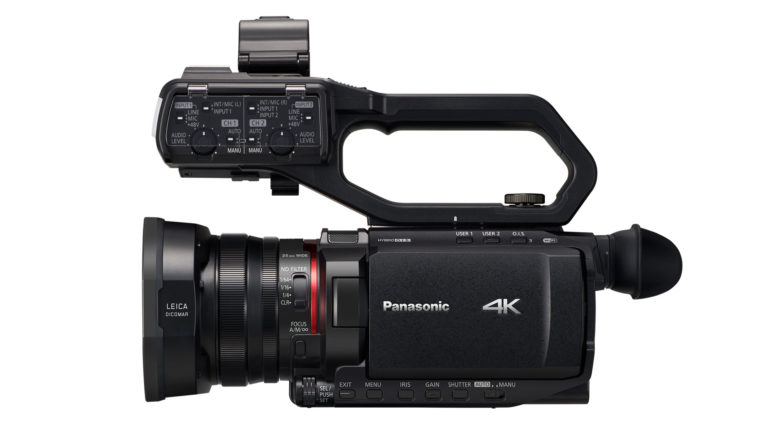
Panasonic unveiled its P2 strategy for the new year today by announcing the AG-HPX500 — a new 2/3-inch 3-CCD shoulder-mounted HD camcorder that takes interchangeable lenses and offers 11 variable frame rates ranging between 12 and 60 fps. The camera ships in May and sells for $14,000, including viewfinder. And the company’s solid-state P2 recording technology is set to take a big step forward, jumping in May from a maximum of 8 GB to a much more attractive 16 GB on a single card.

Panasonic AG-HPX500

Panasonic AG-HPX500

A Key Camera and 'P2 Gear'

The HPX500’s pricing is aggressive for a 2/3-inch camcorder, and Panasonic Broadcast officials called it the company’s “key product” for 2007. The CCDs are a new version of the sensor used in the SDX900, with Panasonic’s spatial-offset technology bringing the resolution to HD. Naturally, it can shoot a raft of formats: 1080/60i, 50i, 30p, 25p and 24p; 720/60p, 50p, 30p, 25p, and 24p; and DVCPRO50, DVCPRO and DV. It has eight gamma modes, a chromatic-aberration compensation function, and sports four XLR audio inputs.

The new camera is complemented in the field by the AG-HPG10, a new rugged portable (two pounds, battery-powered, with a 3.5-inch 4x3 screen) P2 HD player/recorder, the P2 Gear. It has IEEE 1394 and USB 2.0 connectivity, making it an especially versatile tool for transferring content or acting as a back-up recorder. It ships in August for $3995.

Panasonic 16 GB P2 card and AG-HPG10 Player/Recorder

Panasonic 16 GB P2 card and AG-HPG10 Player/Recorder

Plenty of Time For P2?

“The idea of not having enough [recording] time in the camera goes away with these products,” said Joe Facchini, director of product marketing for Panasonic Broadcast, referring to the new roadmap for P2 media capacity. P2 users who have been getting restless over the delayed introduction of 16 GB P2 cards (which were originally tipped for delivery in 2006) will be heartened to hear that the cards are finally slated to begin shipping in May. They will work immediately with the HPX500 and the AG-HVX200, but other P2 products will require free software upgrades to handle the new, higher-capacity cards. The AJ-HPX2000, for instance, won’t be upgradeable to handle 16 GB cards until August — but when that happens, it will be able to record up to 80 minutes of full-frame-rate DVCPRO HD content to cards in its five P2 slots.

If that’s not enough solid-state recording for you, Panasonic vowed to deliver a 32 GB P2 card, again doubling capacity, by year’s end. Combined with the new, super-efficient AVC-Intra codec (an intraframe codec for professional applications, representing a step up from the consumer-oriented AVCHD long-GOP format), which isn’t ready for prime time but should become attractive once third-party NLE support is firmed up, P2 shooters will soon have an awful lot of ways to balance quality against capacity. “They want media-less cameras,” said Facchini when asked about the needs of P2 videographers in the field — for instance, the six camera crews that are slated to cover the upcoming Iditarod dog race with the existing generation of 8 GB P2 cards. “Their ideal workflow would be to put 32 GB cards in a camera and close the door and bolt it shut. And you could almost do that with 32 GB cards.”

“If you think about the AJ-HDX900, which we introduced last summer, it records 30 minutes on tape — and this is a typical HD camera,” said Panasonic Broadcast VP of Marketing Robert Harris. “You far exceed that recording capacity with the existing four card slots on the HPX500 or five card slots on the HPX2000. So this year recording time really isn’t an issue anymore.”

Panasonic AK-HC3500 (left) and BT-LH80W (right), not to scale

Panasonic AK-HC3500 (left) and BT-LH80W (right), not to scale

Another Camera, and an LCD Monitor/Viewfinder

In other camera news, Panasonic announced the AK-HC3500, a 2/3-inch, 2.2-megapixel 3-CCD HD camera for studio and EFP applications. The camera’s low-profile design borrows features from the VariCam, and the native-1080i sensors use single-channel transfer CCDs and spatial-offset to generate a particularly high-resolution image (1100 horizontal lines). Officials also highlighted the camera’s new 38-bit digital signal processor. It’s slated for a late summer shipment, with a price TBA.

And the BT-LH80W is a nifty hybrid — a standalone 7.9-inch HD/SD LCD monitor that’s also designed to work as a camera viewfinder (for Panasonic cams and others). It boasts focus-assist capabilities, including a pixel-to-pixel matching function that lets you zoom in to see a portion of your HD image mapped precisely to the screen’s 800x450 resolution. It’s slated to ship in July for less than $3,000.


Comments (10) for "Panasonic Announces $14,000 2/3-Inch P2 Camcorder, Ups Cards to 16 GB"
1.
14K Varicam?
Posted by gil on Wednesday, February 14, 2007 @ 10:28 AM
2.
Did Panasonic not quote the writer of this article the prices for the 16Gb and pending 32GB P2 cards? It's a significant ommission. Also, what solutions are offered for low cost HD archiving of finished projects? I understand the least expensive DVC Pro HD deck still comes in at $20K last time I inquired. This makes a $14,000 camera look more like a $40,000 finishing solution to end users.
Posted by Mark-Dawson Van Drie on Wednesday, February 14, 2007 @ 12:16 PM
3.
More "spatial offset" to get to HD, while other companies such as Red provide a full 35mm sensor.

Get with the program, Pannie.
Posted by JohnnyVideo on Wednesday, February 14, 2007 @ 08:10 PM
4.
Nice to know in advance of NAB, especially prices.
However, it would be nice to know what a "ready to shoot-with" package will end up costing, since the lens (and possibly other necessary items) are additional.

Now if we could see some cameras with native 1920x1080 imagers...
Posted by TedL on Thursday, February 15, 2007 @ 12:11 PM
5.
16 GB P2 card prices haven't been announced, but look for them to be competitive on a per-GB basis with the current 8 GB cards, which run $1200.

As far as workflow/archiving, Panasonic doesn't talk much about using DVCPRO decks in a P2 workflow. They're more about hard disk for short-term storage and Blu-ray data discs for long-term. I'm sure tapes come in handy in a lot of environments, especially if your client expects to receive the work on tape, but the company line on P2 is very file-centric.
Posted by Bryant Frazer on Thursday, February 15, 2007 @ 04:41 PM
6.
When will we see a next gen camera with a 200 form factor but 2/3" chips. They didn't sell 20,000 cameras just because they looked nice. There is a need for a high end camera in that form factor...as close to the size of a Red One as possible.
Posted by Gary Pillon on Thursday, February 15, 2007 @ 05:00 PM
7.
Quote: "Now if we could see some cameras with native 1920x1080 imagers..."

The Grass Valley Infinity will have 3 x 2.4million pixel 1920 x 1080 CMOS sensors.
Posted by Peter Corbett on Thursday, February 15, 2007 @ 07:43 PM
8.
a 2/3" 3 chip camera the size of the HVX200 would be physically impossible. The lens mount and chip set needs more room, just as a 35mm film camera is larger than a 16mm camera. I think the Red One is a single, CMOS camera. It has 12 million pixels, but one chip, which takes up less space than a 2/3" 3 chip prism set-up. The new Panasonic HPX500 looks smaller than most 2/3" cameras. I'll check it out at NAB.
Posted by Bruce Frankel on Friday, March 9, 2007 @ 06:50 PM
9.
I use P2 everyday to shoot news for a television station. I've got 1 8GB and 4 4GB cards. Its a solid format but not for the pro freelancer yet and not for most small video businesses. When the price of the cards comes down look at it again.
Posted by bernard moynahan on Wednesday, April 4, 2007 @ 06:45 PM
10.
This is not the end of it. HPX3000 with native 1080p will be out near the end of this year. Price is not the same though, abot $50K body. This is in no way can replace the venerable 720p Varicam. It doesn't even have that rich look. Looking at NAB, the HPX500 doesn't feel as good as the HPX2000. According to Panasonic reps, it's based on the HVX200 dsp. I have 2nd thought. If I'm going to invest a camera w/ a 5-year usage, I need something that can last. 1080i is not a true 1080i. It's bumped up fr. the 720p CCDs. In the end, the realistic workflow w/ the variable frame rate is going to be 720p. No proxy nor AVC expansion. Tempting, but not a risk-free investment.
Posted by The Spectman 12 on Tuesday, April 24, 2007 @ 02:07 PM

Bookmark and Share

Post a Comment

Name:
Email:
Comments:

Please enter the letters or numbers you see in the image.
Your message will be reviewed before it is posted

Subscribe to StudioDaily Podcast


        brand new  
  Studio/monthly magazine   store   rich media tutorials  
 
Studio/monthly magazine

Subscribe to Studio/monthly and catch up, anywhere you go, on top production and post trends, tutorials and product reviews. Click here to get it delivered to your doorstep.

   
video tutorials

All New Video Tutorials.. Avid, Final Cut- RED camera tutorials, Imagineer mogul, Trapcode Form, Apple Motion and many more tutorials on editing, VFX, animation.


    STUDIO DAILY © 2008 Access Intelligence LLC. All Rights Reserved.


Related Content